Skip to main content Go to full content index
Home
Open search

Header menu

  • Contact us

Main navigation

  • Have your say
    • Have your say
    • Key projects
  • News & reports
  • Get involved
    • Ways to get involved
    • Volunteer
    • Events
    • Have your say
    • Work with us
    • Youth Healthwatch
    • 1st Friday Focus
  • What we do
    • About us
    • Our board
    • Our staff
    • Our impact
  • Advice & information
    • General advice
    • Find services
    • Help making a complaint
    • Coronavirus: advice and guidance
Enter the terms you wish to search for.

News and reports

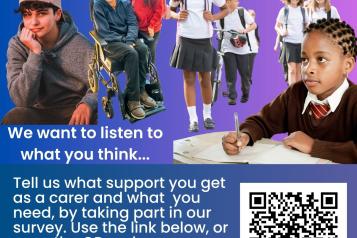
Young Carers unmet social care needs

Healthwatch Walsall work to ensure that health and social care meet the needs of local people. We know that young carers like you play a vital role in supporting your family members or loved ones, but your own needs and experiences can go unheard. This survey is your chance to share your thoughts about the support available to you - whether from schools, healthcare services, or the community. Your feedback will help us highlight what's working well and where improvements are needed.
5 March 2025
News
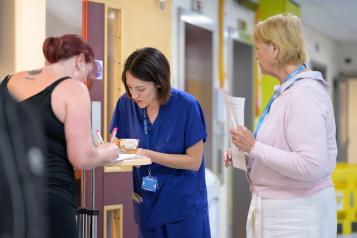
Three women in a hallway filling out a form. Two are clinicians.

Prevent the spread of norovirus

People in the Black Country are being reminded of the simple actions that they can take to reduce the spread of norovirus.
Norovirus is a stomach bug that causes vomiting and diarrhoea. It can be very unpleasant, but symptoms usually go away within a few days.
Symptoms of norovirus start suddenly within one to two days of being infected and can include:
• feeling sick (nausea)
• diarrhoea
• being sick (vomiting)
• a high temperature
• a headache
• aching arms or legs.

The virus can be transmitted easily from person to person and is usually spread through close contact with someone with norovirus, contact with contaminated surfaces or objects or by eating food that’s been prepared or handled by someone with norovirus.
People with norovirus and in need of medical help are being reminded to avoid visiting services in-person, and instead use NHS111 online in the first instance
4 March 2025
News
""

GPs strike deal to help end '8am scramble' for appointments

atients will be able to book more appointments online and request to see their usual doctor under a new contract agreed with England's GPs, the government has said.

The deal gives an extra £889m a year to general practices, as well as a reduction in red tape and targets that ministers hope will mean doctors are freed up to see more patients.

The Labour government made manifesto promises to bring back "family" doctors and end the early morning phone "scramble" for appointments.
3 March 2025
News

Women's Health Questionnaire

Several partners working in the Borough including health, and the voluntary sector want to ask women and girls about their health. We want to listen to what matters to you and help to develop solutions.

The survey asks a number of questions which will help to better understand women’s health issues in Walsall.
25 February 2025
News

Are you a service user of integrated care? Do you have an interest in how health and social care can work together?

Expressions of interest should be submitted to Aileen Farrer, Healthwatch Walsall
Email: aileen.farrer@healthwatchwalsall.co.uk
21 February 2025
News

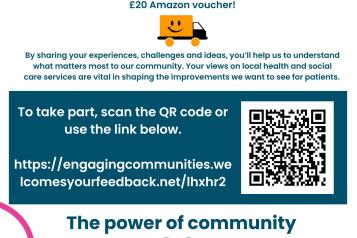
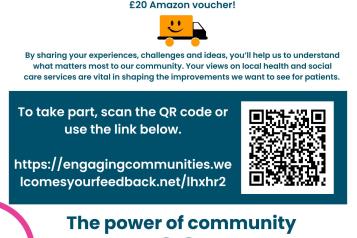
Share your thoughts on the what services or issues we should look at this year?

What do you think our priorities should be for 2025/2026? Take part in our listening survey to get YOUR views shared!
To say thank you, we can enter you into a prize draw to win a £20 Amazon voucher!
By sharing your experiences, challenges and ideas, you’ll help us to understand what matters most to our community. Your views on local health and social care services are vital in shaping the improvements we want to see for patients.
19 February 2025
News

Our latest Enter and View report for Saddlers Health Centre is now available

Read or download a copy.
17 February 2025
Report

RSV vaccine reminder

Eligible people in the Black Country are being reminded to come forward for the
respiratory syncytial virus (RSV) vaccine.

RSV is an infectious disease of the airways and lungs which spreads all year round. It often causes symptoms like a cold, such as a runny nose, cough and fever, and usually gets better by itself. However, for infants and older adults the virus can lead to more severe illness and hospitalisation.

Since last September, people aged 75 to 79 have been eligible to come forward for a free vaccine to protect them from RSV. Pregnant women are also offered the vaccine from 28 weeks into their pregnancy to help protect their babies from RSV for the first few months after they’re born.

In the Black Country, almost 19,000 eligible 75–79-year-olds and roughly 4,000 pregnant women have been vaccinated against RSV to date.

The NHS is sending invites to make an appointment from this week to people not yet vaccinated who are aged 75 to 79 or turned 80 after 1 September 2024. Pregnant women over 28 weeks will be offered the vaccine by the maternity service they are receiving antenatal care from.

Sally Roberts, Chief Nursing Officer for the NHS Black Country Integrated Care Board, said: “In most people, RSV causes a mild illness with cold-like symptoms that usually gets better by itself. However, it is particularly dangerous for the elderly and infants and can cause severe implications in the first few months of a child's life.

“Cases of RSV peak each winter, but it’s important to remember that this is not just a winter illness, and it can occur all year round. Having the vaccine is safe and effective and reduces the risk of severe symptoms.
“Only one dose is needed for long-term protection which is why we’re urging anyone eligible to
come forward and get vaccinated as soon as possible.”


14 February 2025
News

Walk-in flu vaccines in the Black Country

Eligible people in the Black Country are being urged to come forward for a flu vaccination.

The flu can be a serious illness, particularly for those with underlying health conditions, the elderly, and young children.

The flu vaccine helps protect those most at risk from getting the flu. If you do get flu and have been vaccinated, the symptoms are likely to be milder and not last as long. This will reduce your risk of needing to go to hospital with serious flu illness.

People are eligible for a flu vaccination if they are aged 65 or over, pregnant, aged 6 months to 64 years in clinical risk groups, live in a care home for older adults, or are frontline health and social care workers.

A host of pop-up clinics have been set up across the Black Country, offering flu vaccinations for all eligible adults until the end of March, with no appointment necessary. To find your nearest pop-up clinic, visit the NHS Black Country Integrated Care Board website.

Sally Roberts, Chief Nursing Officer for the NHS Black Country Integrated Care Board, said: “The flu vaccine is the safest and most effective way to help protect against flu and is designed to help protect those who are most at risk from developing complications from the virus, helping to minimise hospitalisations.
“It is important to top up your protection, even if you have had a vaccine or been ill with flu before, as immunity fades over time and these viruses change each year.

“That’s why we are reminding all eligible individuals that it’s not too late to come forward for the flu vaccine, if they haven’t taken up the offer of getting it already.

Sally Roberts, Chief Nursing Officer for the NHS Black Country Integrated Care Board, said:
“The flu vaccine is the safest and most effective way to help protect against flu and is designed to help protect those who are most at risk from developing complications from the virus, helping to minimise hospitalisations.

“It is important to top up your protection, even if you have had a vaccine or been ill with flu
before, as immunity fades over time and these viruses change each year.

“That’s why we are reminding all eligible individuals that it’s not too late to come forward for the flu vaccine, if they haven’t taken up the offer of getting it already “Flu vaccinations are available until the end of March, but it’s best to get vaccinated sooner to protect yourself during winter.”
10 February 2025
News

What do you think our priorities should be for 2025/2026?

Take part in our listening survey to get YOUR views shared!

To say thank you, we can enter you into a prize draw to win a £20 Amazon voucher!

By sharing your experiences, challenges and ideas, you’ll help us to understand what matters most to our community. Your views on local health and social care services are vital in shaping the improvements we want to see for patients.
6 February 2025
News

FGM support available in the Black Country

Victims of FGM are being supported by a dedicated service in the Black Country.

Female genital mutilation (FGM) is a procedure where the female genitals are deliberately cut, injured or changed, but there's no medical reason for this to be done.

It's also known as female circumcision or cutting and is illegal in the UK. FGM is usually carried out on young girls between infancy and the age of 15, most commonly before puberty starts.

In the Black Country, there are two dedicated clinics offering support for pregnant women and non-pregnant women, run by Sandwell and West Birmingham NHS Trust.

The clinics opened back in 2019 and have recently been commissioned for a further three years by the NHS Black Country Integrated Care Board. The service is run by specialist lead midwife Alison Byrne, who has more than 22 years’ experience within this field.

Basma Kamel, 32, was born in Egypt and underwent FGM when she was just nine years old. She moved to the UK in 2019 and was referred by her GP to the FGM clinic for non-pregnant women at Summerfield Primary Care Centre, where she received support.

She said: “I remember being nine years old and going to a clinic in Egypt with my mother to see a doctor who performed an exam on me. During the exam he said I needed to be circumcised, and I was booked in the next day to have the procedure. I was only given local anaesthetic during the procedure, so I was awake during the whole thing, and I could feel everything. They tried to give me a bigger dose of anaesthetic, but it didn’t work, and I can still vividly remember feeling the scissors as they cut me. Because of this, the circumcision wasn’t fully completed and still have part of my labia left which has caused quite a few health issues over the years.

“I moved to the UK back in 2019 and when I went to see my local GP, he referred me to the FGM clinic where I received both physical and psychological support by Alison and the team. It was the first time since I had FGM as a little girl that I’d received any professional support, and it’s made such a difference. It’s been more than five years since I was first referred to the clinic and I’ve since moved to London, but Alison still checks in on me every now and again to see how I am which is lovely.

“There’s such a taboo when it comes to FGM, and people don’t talk about it. As women, we learn to suffer in silence but there is support out there. I would urge anyone who is a survivor of FGM to come forward and get help, whether its physical treatment or wellbeing support.”

Alison said: “FGM is very painful and can seriously harm the health of women and girls. It can
also cause long-term problems with sex, childbirth and mental health.

“Survivors of FGM deserve to be heard and supported which is why our FGM service is so important. We know that damage caused by FGM affects women differently and so we ensure every woman’s care package is tailored to their specific needs, whether that’s physical or emotional.

“We have two clinics, one for pregnant women and one for non-pregnant women which run twice a month and is available for all women and girls who have been affected by FGM. The services we offer help many women who sometimes are unsure about how to access care or treatment after undergoing this procedure.

“The service is discreet and care is provided in the strictest of confidence, so I would encourage anyone who needs to support to get in touch.”

The clinic for pregnant women is held in the Maternity Department at the Midland Metropolitan University Hospital in Smethwick. Community or antenatal midwives will refer women into this particular clinic The clinic for non-pregnant women is held at Summerfield Primary Care Centre, in Heath Street, Winson Green, which is near the Midland Met. Women can self-refer or be referred by their GP, or alternatively anyone can refer a woman to the clinic.
5 February 2025
News

Pop-up cancer conversations in the Black Country

To mark World Cancer Day (Tuesday 4 February), a series of pop-up cancer conversation shops are taking place across the Black Country next week to raise awareness of the signs and symptoms of cancer and screening programmes.

Organised by the local NHS in partnership with the four local authorities in the Black Country, the pop-up shops are an opportunity for local people to meet and talk with a range of clinicians about how to check for symptoms of cancer, screening programmes the support services available and what to do if they’re concerned.

Attendees will be given information on the breast, bowel, cervical and lung NHS cancer screening programmes including when people will be invited and what's involved in the screening. Local support also will be offered for people living with and beyond cancer.

People will also be offered a health check on the day, including blood pressure checks and
blood sugar tests.

Dates and times for the pop-up shops are:
• Friday 7 February, Shop next to costa Coffee, Upper Floor, Park Mall, Sadler’s Centre, Walsall, 10am to 3pm.
• Tuesday 4 February, Urban Rooms, 19 Queen’s Square, Wolverhampton (opposite NatWest bank), 10am-3pm.
• Saturday 8 February, Brierley Hill Market, at the back by the café, High Street, Brierley Hill, 10am to 3pm.

Early detection is the most effective defence against cancer, and people must understand the signs and symptoms to watch for, as well as the screening programmes available.

Dr Mona Sidhu, Medical Director of Primary Care for the NHS Black Country Integrated Care Board (ICB), said: "This is why initiatives like the cancer pop-up conversation shops are so important. They provide an invaluable opportunity to engage with individuals one-on-one about cancer - especially those who may not realise they are at risk, may not recognise potential symptoms, or feel hesitant or fearful about taking action.

"Remember, if you notice something unusual for you or something that isn't going away, it’s important to consult your GP. While it’s likely not cancer, identifying it early can make a significant difference if it is."

30 January 2025
News

Pagination

  • First page « First
  • Previous page ‹ Previous
  • …
  • Page 5
  • Page 6
  • Page 7
  • Page 8
  • Current page 9
  • Page 10
  • Page 11
  • Page 12
  • Page 13
  • …
  • Next page Next ›
  • Last page Last »

Footer menu - Primary

  • Jobs
  • Contact us

Find Healthwatch on social media:

Twitter External link icon Facebook External link icon Instagram External link icon
Opens in a new window Opens an external site Opens an external site in a new window YouTube External link icon LinkedIn External link icon RSS External link icon
Healthwatch logo

Footer menu - Secondary

  • Terms & conditions
  • Accessibility
  • Cookies
  • Privacy
  • Log in

© Healthwatch 2022